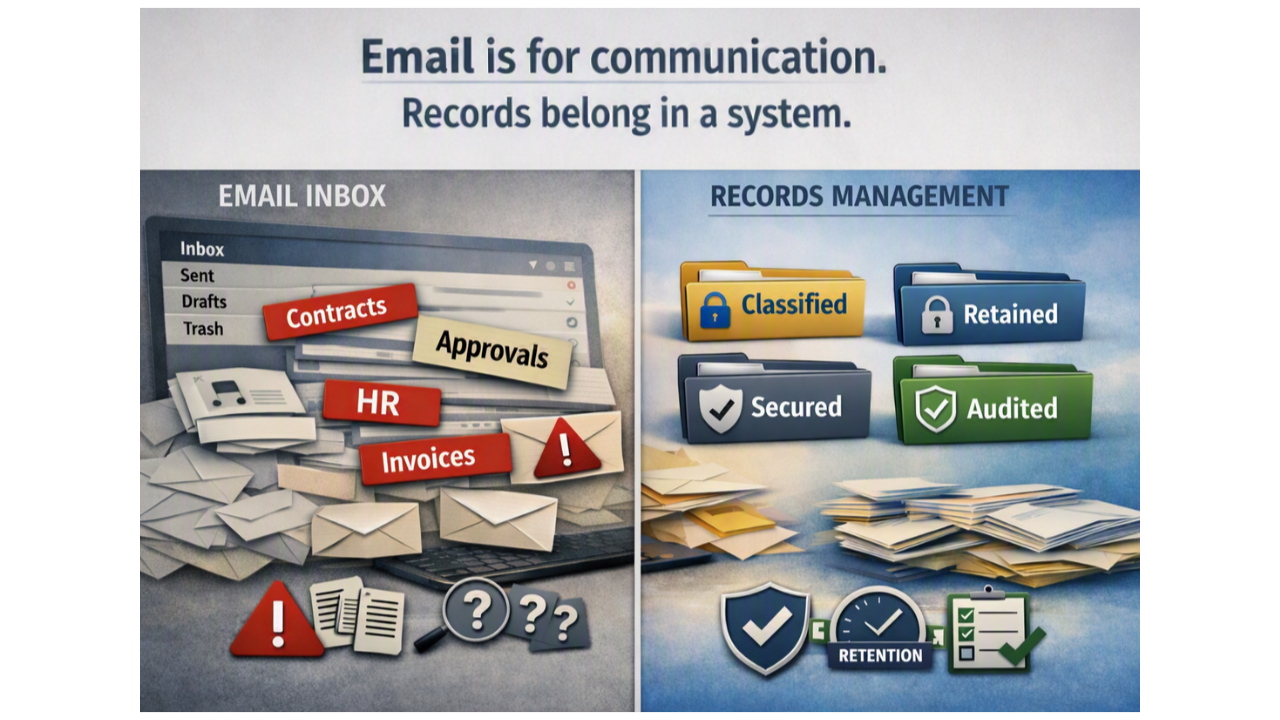
The Dangers Of Using Email As A Records Storage System.
Email is one of the most common places where business information ends up. Engagement approvals, contracts, evidence, decisions, attachments, you name it.
But here’s the truth that most businesses don’t realise: Your inbox is the most dangerous place to store records!
If your business is relying on email as a filing system, you’re exposing yourself to compliance risks, lost information, and operational chaos.
Let’s break down why.
Email was never designed to be a records system.
Email is a communication tool not a controlled storage environment. When staff treat their inbox like a filing cabinet, the business loses the structure and control that records management requires. Messages pile up, attachments get buried, and important information becomes scattered across hundreds of personal inboxes.
This lack of control means you lose:
Structure
Consistency
Retention Control
Security
Accountability
Without the above, it becomes impossible to know what records exist, where they are stored, and who has access to them. Email simply cannot provide the governance that a Records Management System delivers.
Critical business decisions get buried, or lost.
Many businesses rely on email for approvals, instructions, and key decisions. However, inboxes are private spaces, not shared filing systems. When important decisions sit inside individual inboxes, the business loses visibility and traceability. If someone deletes an email, changes role, or leaves, that evidence disappears with them.
If the business relies on email as proof of decisions, you’re one resignation away from losing vital information!
Attachments create version chaos.
Email attachments are one of the biggest contributors of duplication and confusion. A single document can quickly turn into multiple versions when staff download, save it locally, rename it, edit it, and send it back. Before long, nobody knows which version is correct and mistakes become inevitable.
This is how errors happen, how deadlines get missed, and how audits fail. Email encourages fragmentation, not control.
Sensitive information sits unprotected.
Contracts, HR documents, financial information, and confidential records often sit inside inboxes with no protection. Unlike a structured Records Management System, email provides no meaningful security control. Anyone with access to the inbox can view sensitive information, and there’s no monitoring or classification to ensure its handled correctly.
Inboxes typically have:
• No access control
• No retention rules
• No monitoring
• No security classification
Email is the least secure place to store sensitive records, yet it’s where they often end up.
What should businesses do instead?
The solution is simple, move records out of inboxes and into a structured, controlled Records Management System. A proper RMS ensures information is classified, retained, secured, accessed, audited, and managed in line with business and compliance requirements. Email should support communication, not act as a filing system. By shifting records into a Records Management System you bring back the clarity, consistency, and control your business needs.
If you’d like help moving your business away from email based storage and into a simple, reliable system, we’re here to help.